
Yes, AI is already doing many of the tasks VAs charge for. Inbox management, scheduling, meeting notes, basic research, first-draft content. If your entire value is tied to those tasks, you are exposed, and pretending otherwise will not help you.
But here is the part the scary headlines leave out. AI is not replacing virtual assistants. It is replacing tasks. The VAs who learn to use these tools better than their clients, and who sell outcomes instead of hours, are becoming more valuable, not less. Businesses do not need fewer good people. They need fewer average ones.
This post covers what AI is genuinely automating right now, what it still cannot do, and the six moves that make you hard to replace. There is also a 90-day plan at the end, because worrying is not a strategy either.
I have been in digital marketing since 2007. I ran a VA agency for four years. I use AI every single day in my own business. I am not guessing at any of this.
Is AI actually replacing virtual assistants?
Let me answer this properly, because most of what gets written on this topic is either panic or denial.
The panic version says VAs will be obsolete by next year. The denial version says AI could never do what a human does, usually written by someone who has not opened an AI tool since 2023.
The truth sits in the middle, and it is more uncomfortable than the denial crowd wants and less dramatic than the panic crowd needs.
If a task can be fully described in an instruction, AI can probably do it now, or will be able to soon. That covers a lot of traditional VA work. And clients know it. The business owner who used to pay someone three hours a week to tidy their inbox has now watched a demo of an AI tool doing it in the background for the price of a coffee.
But here is what I see from the other side of the fence, as someone who runs a business and buys support. The tools do not manage themselves. They do not know what matters. They do not notice that the client who usually replies in an hour has gone quiet for a week. They do not take ownership when something goes wrong, and they do not care whether the business succeeds.
Somebody still has to be the person who cares, who decides, and who is accountable. That job is not going anywhere. It is just no longer priced by the hour.
So the honest answer is this. AI is replacing the average VA. The one who does exactly what the task list says and nothing more. It is not replacing the VA who runs things, spots things, fixes things and thinks. If anything, that VA just got a very cheap, very fast assistant of her own.
Which VA tasks is AI already doing?
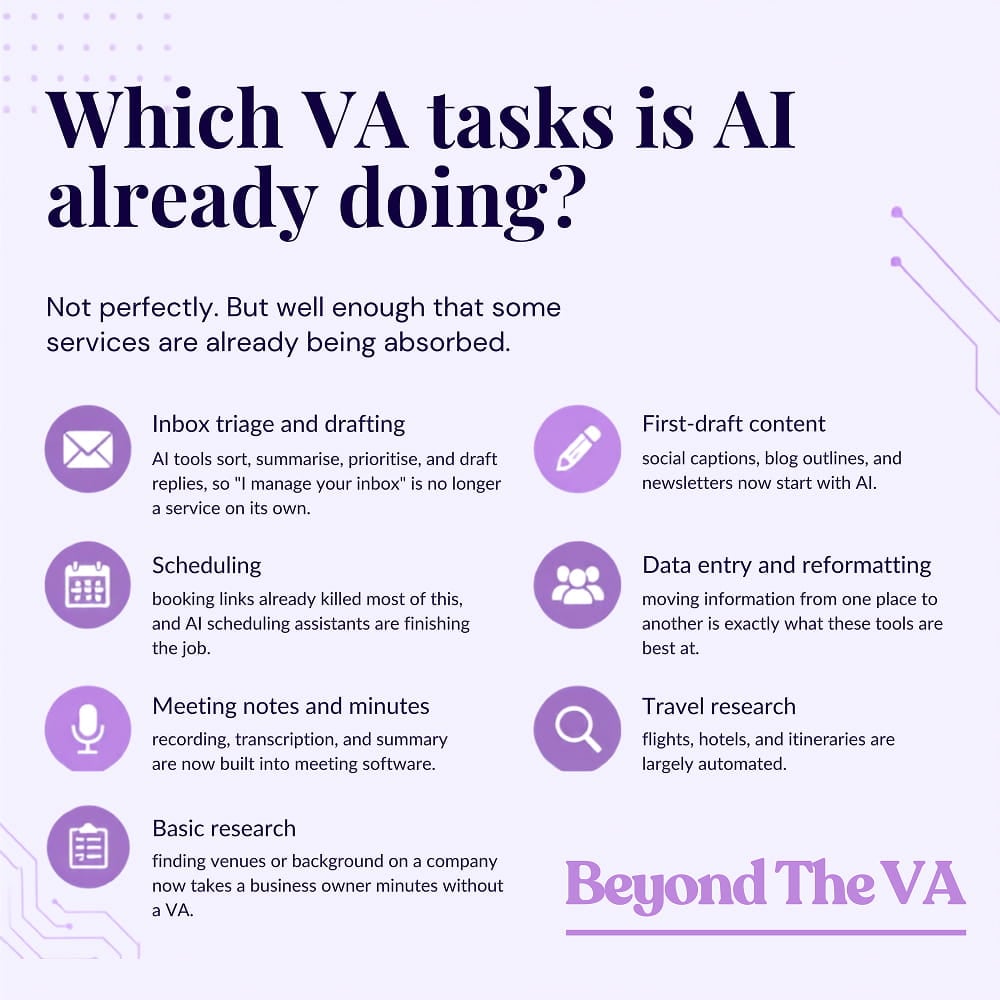
Let us be specific, because vague reassurance is useless. These are the tasks being automated right now, today, not in some distant future:
Inbox triage and drafting. AI tools now sort, summarise, prioritise and draft replies. Not perfectly. But well enough that “I manage your inbox” is no longer a service on its own.
Scheduling. Booking links killed most of this years ago. AI scheduling assistants are finishing the job.
Meeting notes and minutes. Recording, transcription and summary are now a built-in feature of the meeting software itself. Nobody is paying a person to type up minutes any more.
Basic research. “Find me five venues” or “pull together some background on this company” now takes a business owner two minutes without you.
First-draft content. Social captions, blog outlines, newsletters. The first draft is free now. Everyone knows it.
Data entry and reformatting. Moving information from one place to another is exactly what these tools are best at.
Travel research. Flights, hotels, itineraries. Largely automated.
If you read that list and felt your stomach drop, good. That means you are paying attention. Most of your competitors are not, and that is genuinely useful information, because the bar for standing out has never been lower.
What can AI still not do?
This is the list that matters, because it is the list you build your business on.
AI cannot own an outcome. It can draft the newsletter. It cannot be responsible for the newsletter going out on time, to the right list, with the right link, every week, without the business owner ever thinking about it. Ownership is a human service.
AI cannot exercise judgement. It does not know that the email from that particular client is urgent even though it does not look urgent. It does not know the founder hates exclamation marks. It does not know that this supplier is on their last warning. Context lives in people.
AI cannot notice what is missing. It answers the question it was asked. It does not say “you asked me to book the venue, but have you noticed nobody has invited the speaker yet?” The person who spots the gap is worth ten times the person who completes the task.
AI cannot build trust. Business owners hand over their inbox, their invoicing and their customer relationships to people they trust. That trust is built over time, through reliability, honesty and care. There is no tool for it.
AI cannot manage AI. This is the big one. Somebody has to choose the tools, set them up, check the output, catch the errors and stitch it all together into something that actually runs. Most business owners do not have the time or the patience. That is a job. It might be the best VA job there has ever been.
AI does not care. It will never lie awake wondering if the launch will go well. Your clients can feel the difference, even if they cannot name it.
Look at that second list and notice something. None of it is priced sensibly by the hour. Judgement, ownership, trust and care are outcomes. Which brings me to the whole point.
So what does the successful VA look like now?
Sell outcomes. Not hours.
That is the entire philosophy behind Beyond The VA, and the AI shift is exactly why it matters more now than ever.
When you charge by the hour, you are a cost, and AI makes every hour cheaper. You are in a price war with a robot, and you will lose. Not because you are worse. Because the robot works nights and does not invoice.
When you sell a result, the comparison disappears. “Your inbox at zero, your invoices paid, your newsletter out every Thursday, without you thinking about any of it” is not competing with a £15 a month tool. It is competing with the business owner doing it themselves at 11pm, and it wins easily.
The successful VA in 2026 is not the person AI replaced. She is the person the business owner calls because AI exists and they have no idea what to do with it. She uses the tools daily. She knows which ones are good and which are hype. She has quietly automated half her own workload and used the freed-up time to serve more clients, at better prices, on outcomes.
The tools did not shrink her business. They became her staff.
How do I make myself hard to replace? The five moves
None of this is complicated. All of it takes actual doing. In order:
- Use the tools before your clients do
You cannot outrun AI, so get in front of it. Pick one tool at a time and genuinely learn it. Not a YouTube video and a vague sense of dread. Actual use, on your own business first. Your goal is simple: you should be better at using AI than every one of your clients. When a client says “should we be using AI for this?”, the most valuable sentence in your business is “yes, and I already do, here is how.”
- Repackage tasks as outcomes
Go through your service list and rewrite every line. “Inbox management, 5 hours per week” becomes “you never see an email that does not need you.” “Social media scheduling” becomes “your business shows up online every day without you touching it.” The work may look similar. The value, the pricing and the client conversation are completely different. You are no longer selling hours that AI can undercut. You are selling a result that AI cannot own.
- Pick a lane
The generalist “I can do anything” VA is the most exposed person in this whole shift, because “anything” is exactly what the tools claim too. Specialists survive. Pick an industry you know, or a problem you are genuinely good at, and become the obvious choice for it. It feels like turning work away. It is actually how you stop competing on price with every VA and every tool on the planet.
- Put AI inside your service, not next to it
Do not sell “AI services” as a bolt-on. Build the tools into how you deliver, then charge for the improved result. If AI cuts a four-hour task to one hour, you have two choices. Bill three fewer hours, or deliver the outcome and keep the efficiency. One of those is a business. The other is volunteering to take a pay cut for being good at your job.
- Be the one who notices
The cheapest thing you can do, starting today, costs nothing. Spot things. Flag the gap, question the date that does not look right, suggest the better way. Every time you catch something your client did not see, you move further from “person who does tasks” and closer to “person I could not run this without.” No tool on earth is in that second category.
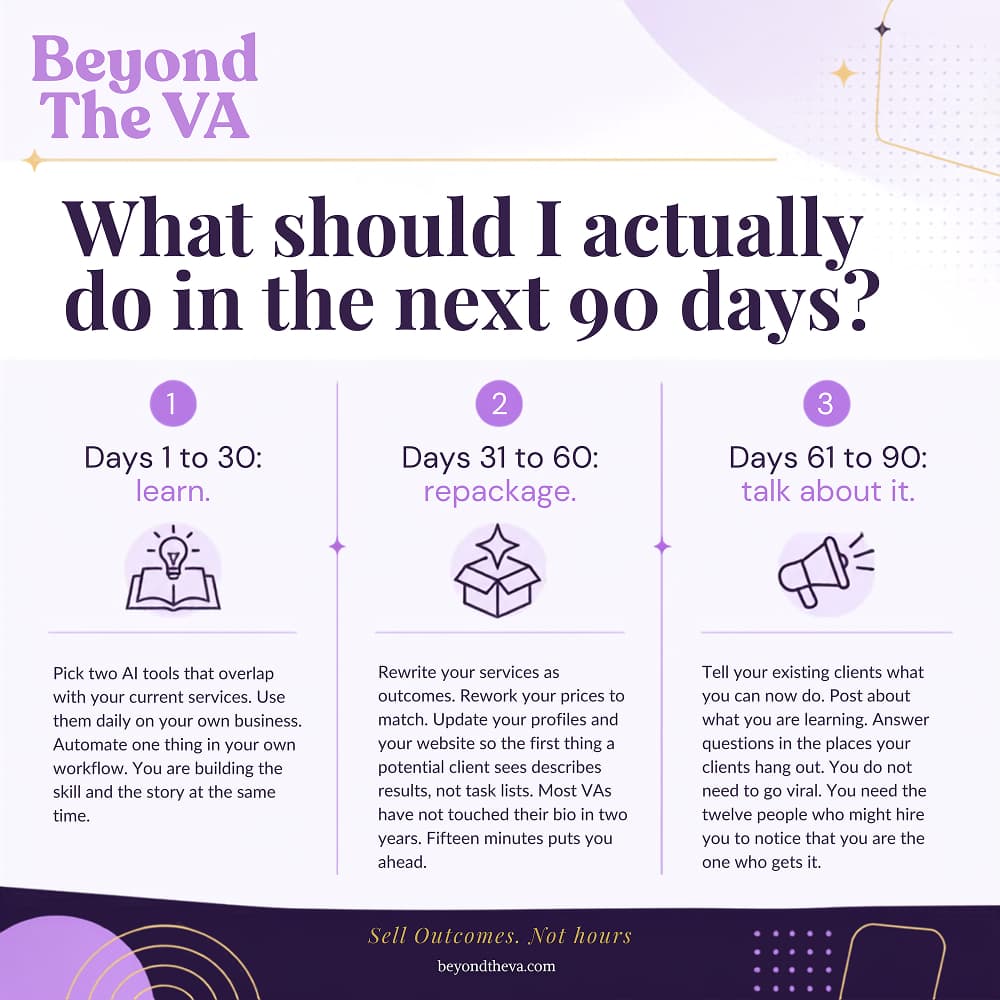
What should I actually do in the next 90 days?
 Worry is not a plan. Here is one.
Days 1 to 30: learn. Pick two AI tools that overlap with your current services. Use them daily on your own business. Automate one thing in your own workflow. You are building the skill and the story at the same time.
Days 31 to 60: repackage. Rewrite your services as outcomes. Rework your prices to match. Update your profiles and your website so the first thing a potential client sees describes results, not task lists. Most VAs have not touched their bio in two years. Fifteen minutes puts you ahead.
Days 61 to 90: talk about it. Tell your existing clients what you can now do. Post about what you are learning. Answer questions in the places your clients hang out. You do not need to go viral. You need the twelve people who might hire you to notice that you are the one who gets it.
Then keep going. Marketing does not fail because it does not work. It fails because people stop before it can work. The same is true of this.
The bit nobody says out loud
Some VAs will not survive this shift. That is the honest truth, and you deserve to hear it from someone rather than find it out through a quiet quarter.
But it will not be because AI took their jobs. It will be because they kept selling hours of tasks while the price of tasks fell to nearly nothing, and they waited for it to blow over instead of adapting.
You are reading a long article about how to adapt. You are already not that person.
The industry is not shrinking. Businesses need more capable support than ever, precisely because the tools have made everything faster and more confusing at the same time. What is shrinking is the space for average. The space for excellent has never been bigger, and it has never been less crowded.
Make hay.
FAQ
Will AI completely replace virtual assistants in the next five years?
No. It will keep replacing tasks, and the pace will not slow down. But the role of a trusted person who owns outcomes, exercises judgement and manages the tools is growing, not shrinking. The job title might survive unchanged. The job description will not.
Should I tell my clients I use AI?
Yes. Hiding it is a terrible strategy, because the moment they find out, and they will, the question becomes “what else are you not telling me?” Be open: these are the tools I use, this is why my turnaround is fast, and everything is checked by me before it reaches you. Handled that way, using AI makes you look sharper, not cheaper.
What if a client asks me to cut my hours because AI can do the work quicker?
This is the hourly-pricing trap catching up with you, and it is your cue to move that client to outcome-based pricing. The conversation is: “You are right that the work is faster now. That is why I price by result rather than time, so you pay for the outcome, not the clock.” If a client only ever valued your hours, they were always going to be a problem. AI just brought the date forward.
Which AI tools should I learn first?
The ones closest to the services you already sell. If you do admin and operations, start with automation tools and an AI assistant for drafting and summarising. If you do content, learn the writing and design tools properly, especially editing AI output so it does not sound like AI. Do not try to learn everything. One tool used well beats ten tools half-known. The newsletter covers one a week for exactly this reason.
I am not technical at all. Is this hopeless?
No, and honestly the “technical” framing is the problem. These tools are built for non-technical people. If you can write a clear instruction to a colleague, you can use AI. The skill that matters is not technical, it is knowing your clients’ work well enough to know what to ask for and to spot when the output is wrong. You already have that.
Is it too late to adapt?
It is genuinely early. Most VAs have not made this shift. Most business owners are confused and looking for help. The people who moved first are doing very well, and the door they walked through is still wide open. Late is ten years from now. This is the useful kind of early, the kind that only feels late because the headlines are loud.
Ready to future-proof your VA business?
Everything in this post is doable on your own. It is just faster with the groundwork done for you.
The Beyond The VA Starter Kit covers the three things that actually decide whether a VA business survives this shift, in three parts. The backend, with Kathryn: contracts, the UK legal and data basics, money habits and a proper onboarding document. Positioning and content, with Roksana: how to stop sounding like every other VA and start saying something clients respond to. And lead generation, with me: the maths, where your clients actually are, and what to send them.
You are good at the work. That was never the problem. The kit sorts out everything around the work.
It is £9. Instant download. No course, no upsell funnel, no hustle. Honestly, it is more than most people put behind a fifty pound paywall, and the best nine quid you will spend on your business this year.
Get the Starter Kit for £9: https://app.beyondtheva.com/btva-starter-kit
And if you are not ready to buy anything, join the free newsletter. One AI tool, one practical task and one thing worth posting, every week. It is free, it is useful, and it will keep you ahead of this shift while everyone else is still worrying about it.
Sell outcomes. Not hours.