
You do not need a course, a qualification or a five-figure “academy” programme to become a virtual assistant. You need a service people will pay for, a simple legal setup, sensible prices, and a way of finding your first clients that does not involve waiting to be discovered.
This guide covers all of it: what VA work actually looks like in 2026 (it has changed, mostly for the better), which services to offer, the UK setup admin, what to charge, the tools you genuinely need, how to land your first client, and the mistakes that sink most new VAs in their first year.
Fair warning: this is long, because it is a real answer rather than a listicle. Read it with a cup of tea and something to take notes on.
I have been in digital marketing since 2007 and I ran a VA agency for four years. I have hired VAs, trained VAs, and watched hundreds start out. The ones who make it are not the most experienced or the most confident. They are the ones who treat it like a business from day one. That is the whole secret, and the rest of this post is the practical version of it.
What does a virtual assistant actually do in 2026?
Ten years ago the answer was “remote admin”. Inbox, diary, typing, travel. Some VAs still do that, but honestly, that version of the job is being automated out of existence, and pretending otherwise would be doing you a disservice.
The 2026 version is broader and more interesting. VAs today run podcasts, manage online communities, handle client onboarding, produce social content, manage e-commerce back-ends, run email marketing, coordinate launches, keep CRMs honest, and increasingly set up and manage the AI tools their clients keep hearing about but do not have time to learn.
The common thread is not admin. It is this: business owners are drowning in operational work that is not the thing they started the business to do. A good VA takes chunks of that off their plate and owns them, so the owner gets their time and their headspace back.
Notice the word owns. Not “does tasks when asked”. Owns. The VAs who get booked, get paid properly and get referred are the ones a client can hand something to and stop thinking about it. That is the product. Everything else in this guide builds towards it.
One more thing worth saying early. AI has changed this industry, and you are starting at exactly the right time because of it, not despite it. New VAs who build AI tools into how they work from day one have a genuine edge over established VAs still doing everything by hand. You have no old habits to unlearn. Use that.
Do I need qualifications or a course?
No qualification is legally required to become a VA in the UK. Nobody will ever ask for a certificate. Clients ask exactly two questions: can you do the thing, and can I trust you with it.
So instead of buying a course, do a skills audit. Sit down and list:
- What you have done in jobs. Every role, every system, every responsibility. Diary management for a director? Minute-taking? Invoicing? Customer service? CRM admin? Event coordination? It all counts.
- What you do that other people find hard. The thing colleagues always asked you to help with is a clue. Spreadsheets, untangling messes, writing the awkward email, organising chaos.
- What industries you know. If you spent eight years in a solicitors’ office or a construction firm or a salon, you understand how that world works. That is worth money to businesses in that world.
Most new VAs dramatically undervalue their own history. You are not starting from zero. You are repackaging fifteen years of being organised and getting on with it.
Where training is worth it: short, specific, cheap. A course on one tool you plan to offer. Not a £3,000 programme promising six figures. If someone is selling you the dream harder than they are teaching you the skill, keep your money.
What services should I offer?
Here is the most common mistake new VAs make, and I want you to hear it before you build anything: the everything menu.
New VAs panic about missing work, so they list every service they can imagine. Admin, social media, bookkeeping, websites, newsletters, travel, research, “and much more!”. It feels safe. It reads as “I am new and I will take anything”, and it attracts exactly the clients who treat you that way.
Do the opposite. Pick two or three services you are genuinely good at, and describe them as outcomes.
Not “inbox management” but “you never see an email that does not need you.”
Not “social media scheduling” but “your business shows up online every day without you touching it.”
Not “general admin support” but “the operational stuff runs without you being in every decision.”
See the difference? Task lists compete on price. Outcomes compete on value. When you charge by the hour for tasks, you are a cost. When you sell a result, you are an investment. Sell outcomes. Not hours. If you take one sentence from this entire guide, take that one.
A few honest pointers on choosing your services:
- Start where your experience is deepest, even if it is not the most exciting option. You can add services later. You cannot easily add credibility.
- Niching feels scary and works. “VA for accountancy firms” or “podcast VA” or “launch support for course creators” will out-earn “VA for anyone” every time. You are not turning work away. You are becoming the obvious choice for someone.
- Watch what people actually pay for. Spend a week in the Facebook groups and communities where small business owners hang out. Write down what they complain about. Those complaints are your service list, in your clients’ own words.
How do I set up as a VA in the UK?
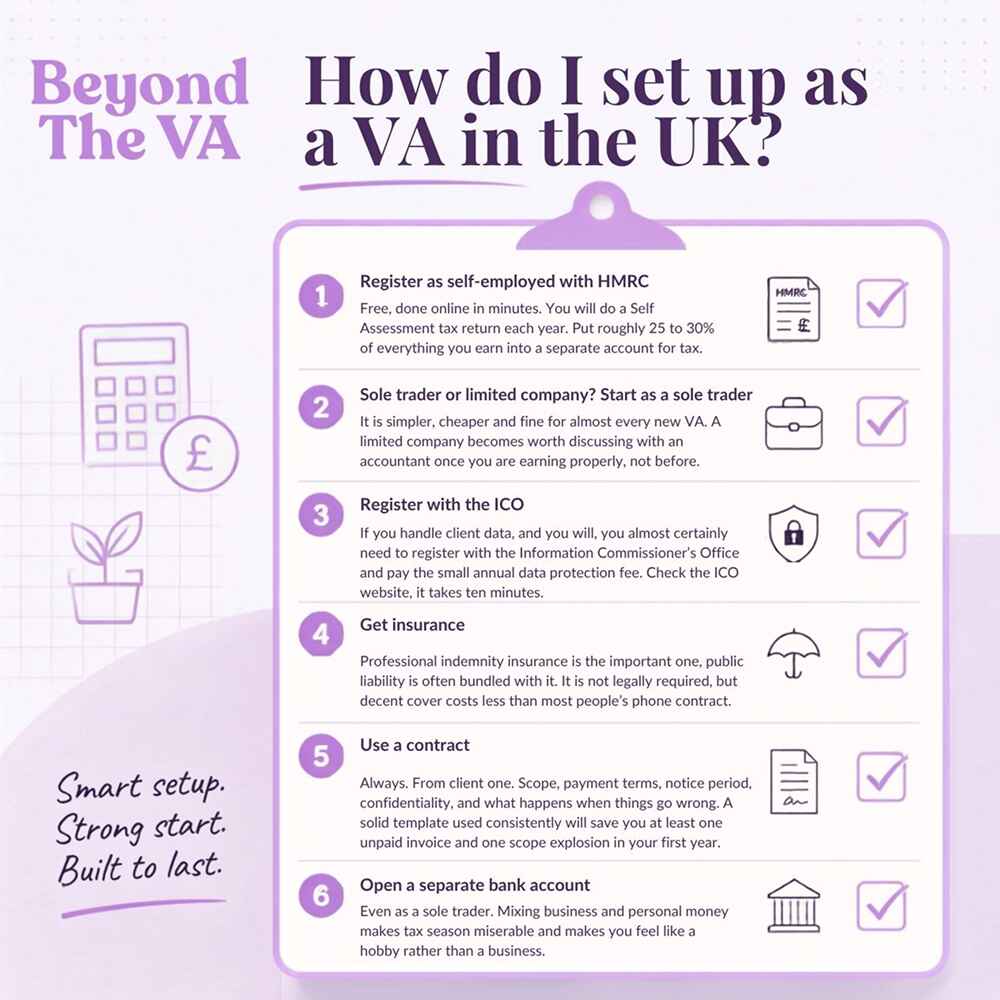
The boring bit. It is genuinely not much, and you can do all of it in a week. (This is the UK version; if you are elsewhere, the equivalents exist and are usually just as painless.)
- Register as self-employed with HMRC. Free, done online in minutes. You will do a Self Assessment tax return each year. Put roughly 25 to 30% of everything you earn into a separate account for tax and you will never have a nasty January.
- Sole trader or limited company? Start as a sole trader. It is simpler, cheaper and fine for almost every new VA. A limited company becomes worth discussing with an accountant once you are earning properly, not before.
- Register with the ICO. If you handle client data, and you will, you almost certainly need to register with the Information Commissioner’s Office and pay the small annual data protection fee. Most new VAs have never heard of this one. Check the ICO website, it takes ten minutes.
- Get insurance. Professional indemnity insurance is the important one, public liability is often bundled with it. It is not legally required, but working in someone’s inbox and invoicing system without it is braver than I would be. Decent cover costs less than most people’s phone contract.
- Use a contract. Always. From client one. Scope, payment terms, notice period, confidentiality, what happens when things go wrong. “But it was a friend” is how most VA horror stories begin. A solid template used consistently will save you at least one unpaid invoice and one scope explosion in your first year. I would put money on it.
- Open a separate bank account. Even as a sole trader. Mixing business and personal money makes tax season miserable and makes you feel like a hobby rather than a business.
That is the lot. Notice what is not on the list: a logo, a brand photoshoot, a perfect website. Those can all wait. Clients buy competence and trust, not branding.
What should I charge?
Deep breath. This is where most new VAs go wrong, and it is almost never in the direction of charging too much.
The classic new-VA move is to look up the lowest hourly rate they can find, undercut it “just to get started”, and plan to raise prices later. Here is what actually happens: you attract the most price-sensitive clients in existence, they fill your week with low-value tasks, you are too busy and too tired to market yourself, and “later” never comes. Cheap is a trap dressed up as a strategy.
Some honest principles instead:
- Do not price at the bottom of the market. In the UK right now, experienced VAs charge roughly £30 to £45+ per hour, and specialists more. As a new VA you do not need to start at the top, but starting in the £27 to £35 range with a professional setup is entirely defensible. Your years of employed experience did not evaporate because you changed how you invoice.
- Move to packages as fast as you can. A monthly retainer for a defined outcome (“podcast produced and published every week”) beats hourly for everyone. The client gets a predictable bill and a result. You get predictable income and you stop being punished for working quickly. This matters double in the AI era: as tools make you faster, hourly billing literally pays you less for being better at your job.
- Use the pause test. If no potential client has ever paused at your price, you are too cheap. You want some people to hesitate. The ones who pause and still say yes are your best clients. The ones who walk away were never going to value the work anyway, and there are plenty of clients out there. You do not need all of them. You need the right ones at the right price.
- Never advertise a rate you resent. Resentment leaks. It comes out as rushed work and quiet bitterness, and clients can feel it.
What tools do I actually need?
Fewer than the checklists say. Do not spend your first month building a tech stack instead of finding clients. The lean version:
- Somewhere to meet: Zoom or Google Meet. Free.
- Somewhere to organise work: Notion, Trello or Asana. Free tiers are plenty. Bonus: a simple shared dashboard showing clients what is done and what is coming saves you three “just checking in” emails a week and makes you look extremely together.
- Invoicing: a proper tool, free or cheap, rather than Word documents. Looks professional, chases late payers for you.
- A password manager. Clients will try to email you their passwords. Politely refuse and set up a proper shared vault. This alone signals that you are a professional.
- Loom or similar. Short screen-recorded videos instead of long explanation emails. Clients love it, and it quietly makes you look like a partner rather than a task-doer.
- An AI assistant, from day one. Use it to draft, summarise, research and check your work. Learn one automation tool as you grow. You do not need to be technical. If you can write a clear instruction to a colleague, you can use AI. Being the VA who is comfortable with these tools is, right now, one of the strongest positioning advantages available to someone starting out.
That is genuinely it. Add tools when a client or a bottleneck demands them, not before.
How do I find my first client?
The bit everyone actually wants to know. First, the mindset: clients do not appear because you exist. A finished website, a nice logo and silence produce nothing. Waiting to be discovered is not a strategy, it is a wish.
What works, in rough order of speed:
- Tell everyone you know. Properly. Not a vague “I’ve started a business!” post. A specific message: “I have set up as a VA helping [type of business] with [outcome]. If you know anyone drowning in [problem], I would love an introduction.” Your first client is very likely two handshakes away, through an old boss, a former colleague or someone at the school gate. Warm beats cold every single time.
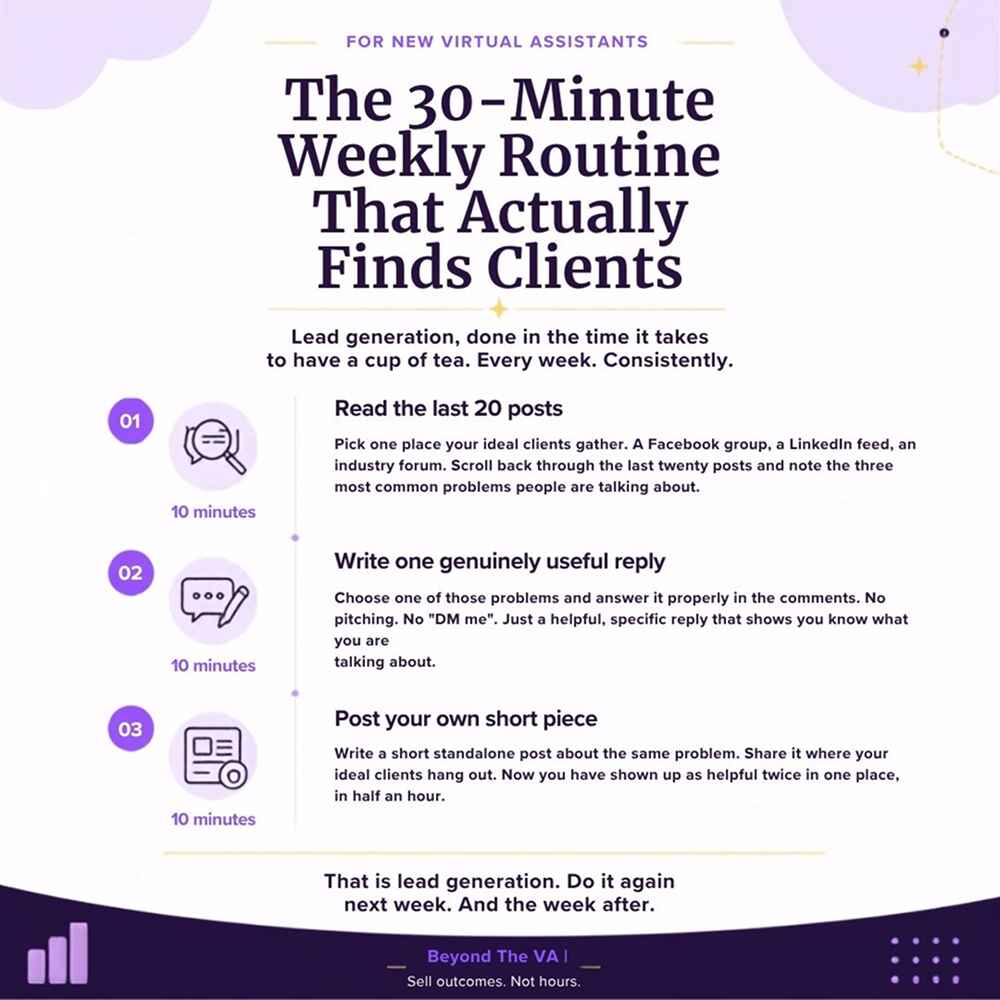
- Go where your clients already hang out, and be useful. Facebook groups, LinkedIn, local business networks, industry communities. Do not pitch. Answer questions. Share what you know. Be the person whose comments are actually helpful. Here is a 30-minute routine that works: find one place your ideal clients gather, read the last 20 posts, note the three most common problems, write one genuinely useful reply, then post your own short piece about that same problem. That is lead generation. It took half an hour. Do it again next week, and the week after. Consistency is not exciting, but it is the reason your future competitors are winning right now.
- Make your profiles say what you do. Before you do any of the above, spend fifteen minutes making sure your LinkedIn and anywhere else a curious client might look actually describes who you help and what outcome you deliver. Most VAs’ bios are two years out of date. The bar is on the floor. Step over it.
- Job boards and VA agencies, with eyes open. They exist, they can bring first work and testimonials, and they are also where price competition is most brutal. Fine as a bridge. Terrible as a home.
And when the first enquiry comes: reply fast, sound human, and offer a short call rather than a wall of text. People hire people.
What mistakes should I avoid?
The greatest hits, collected from years of watching this industry:
- Undercharging “just to start”. Covered above. The trap has a very slow door.
- The everything menu. Also covered. Specific beats general.
- Building the perfect website before finding a single client. Three months of tweaking fonts is procrastination wearing a productivity costume. One page that says who you help, what outcome you deliver and how to contact you is enough to start.
- No contract because the client seemed nice. They all seem nice in week one.
- Ignoring AI. The task-only VA is being automated. The AI-literate VA is being booked. Choose early, because in this market it is genuinely a choice.
- Taking every client. A bad client costs more than an empty slot. Late payers, scope creepers and boundary-testers rarely improve. The politest exit is a price rise.
- Stopping the marketing the moment you get busy. This is the feast-and-famine engine. The 30-minute weekly routine continues even in good months. Especially in good months.
- Doing everything yourself forever. Further down the road: the point of this business is freedom. At some stage that means better systems, higher prices or help. Keep lifting your head up.
How long before this actually pays?
Honestly? Most new VAs land their first client within one to three months of actually marketing themselves, and I mean actually, not “posted twice and went quiet”. Getting to a reliable full-time income typically takes six to eighteen months depending on your network, your niche and how consistently you show up.
Anyone promising you a full client roster in 30 days is selling something, and it is not the truth.
But the honest maths is encouraging. Most VAs need somewhere between three and six retainer clients for a decent income. Not three hundred. You do not need to be famous. You need a handful of the right businesses to know you exist and trust you. That is an achievable number of conversations, and every single one of them can start this week.
FAQ
How much can I earn as a VA in the UK?
Realistically: new VAs typically start around £27 to £35 per hour equivalent, experienced VAs charge £30 to £45+, and specialists or those on outcome-based retainers can go well beyond that. Your ceiling is set less by “market rates” and more by what you sell. Hours have a ceiling. Outcomes do not.
Can I start as a VA part-time alongside a job?
Yes, and it is honestly a sensible way in. One or two small clients in the evenings proves the model, builds testimonials and funds the transition without the terror of a cliff edge. Check your employment contract for anything about second jobs, be scrupulous about not using your employer’s time or kit, and be realistic about capacity. Better to serve one client brilliantly than three badly.
Do I need a website before I start?
No. You need a clear LinkedIn profile and a way to be contacted. A simple one-page site helps later, mostly as a place to point people. What you must not do is spend your first two months building one instead of talking to humans. Website perfection is the most respectable form of hiding.
Should I set up as a sole trader or a limited company?
Start as a sole trader. Simpler admin, lower cost, entirely professional. Revisit with an accountant once you are consistently earning enough that the tax position changes, which is a lovely problem to have and not one to solve in advance.
Can I work with clients in other countries?
Yes, and many UK VAs do. Time zones can even work in your favour. Get paid in a way that does not eat your margin in fees, put the currency and payment terms in your contract, and be aware that handling overseas clients’ data still falls under your UK data protection obligations. None of it is complicated. All of it goes in the contract.
Is 2026 a terrible time to start, with all this AI?
It is one of the best times in years, and I say that as someone who tells VAs the uncomfortable truth about AI for a living. The tools are automating the low-value tasks, which is exactly why businesses need capable humans to own outcomes and manage the tools. You get to build that business from scratch, with no old habits and no legacy pricing to unwind. Established VAs have to change. You just get to start right.
Ready to start properly?
You could piece all of this together yourself over a few months of googling. Or you could start with it done.
The Beyond The VA Starter Kit covers the three things this guide keeps coming back to, in three parts. The backend, with Kathryn: contracts, the UK legal and data basics, money habits and a proper onboarding document, so you are set up like a business from client one. Positioning and content, with Roksana: how to work out your specialism and say something clients actually respond to, instead of sounding like every other VA. And lead generation, with me: the maths behind how many conversations you actually need, where your clients are hiding, and what to send them when you find them.
It is £9. Instant download. It is the start of the conversation, not the end of it, but it is more than most people put behind a fifty pound paywall, and it will save you months of piecing things together alone.
Get the Starter Kit for £9: https://app.beyondtheva.com/btva-starter-kit
Not ready to buy anything? Fair enough. Join the free newsletter instead. One AI tool, one practical task and one thing worth posting, every single week. It is free, it is genuinely useful, and it is built for exactly the business you are about to start.
Sell outcomes. Not hours.